

New Technology Detects Trace Air Pollutants with Unprecedented Sensitivity
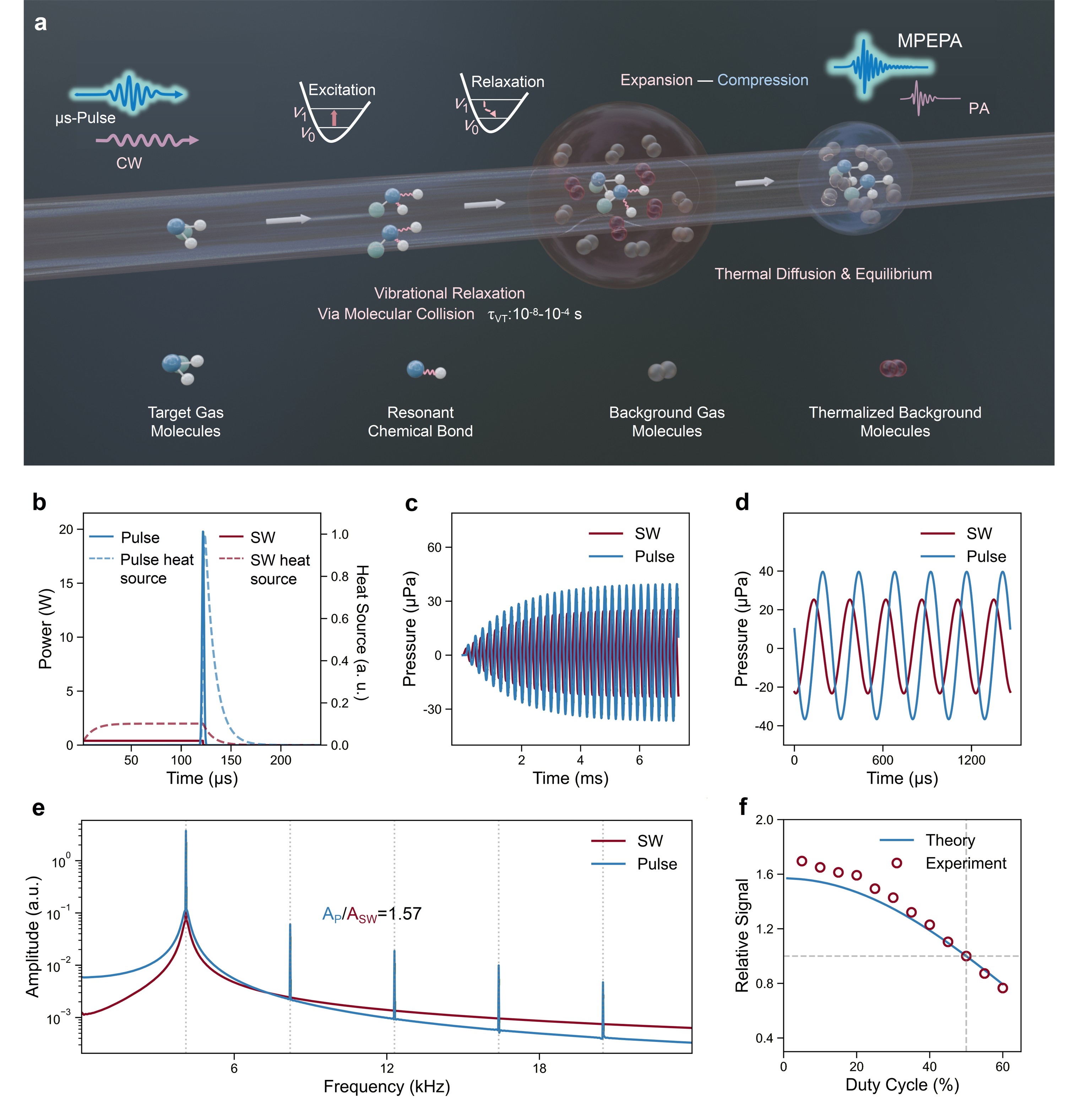
Fig. 1. Schematic and comparison of PA responses from microsecond pulse laser and modulated square wave laser excitation. (a) Schematic of the molecular-level PA process, encompassing vibrational excitation, non-radiative relaxation, and thermal diffusion
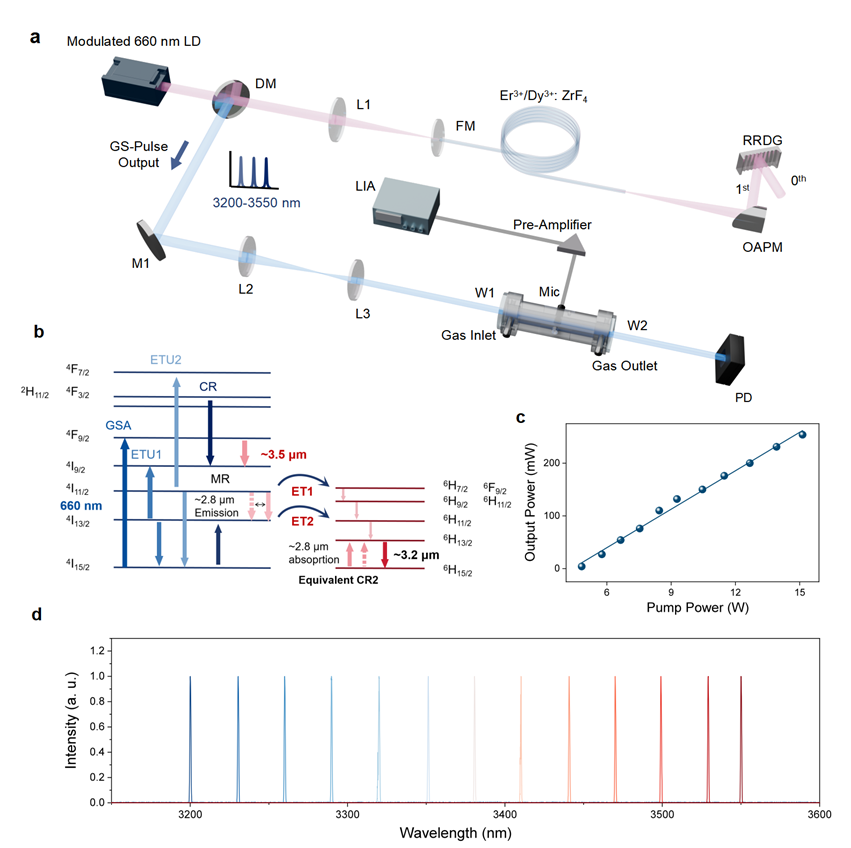
Fig. 2. GS Er3+/Dy3+ co-doped mid-infrared fiber laser based PAS system; (a) The experimental setup of the laser; (b) Energy level diagram of the laser; (c) Pump-output power characteristics; d The tunable spectral output of the laser across 3200-3550 nm.
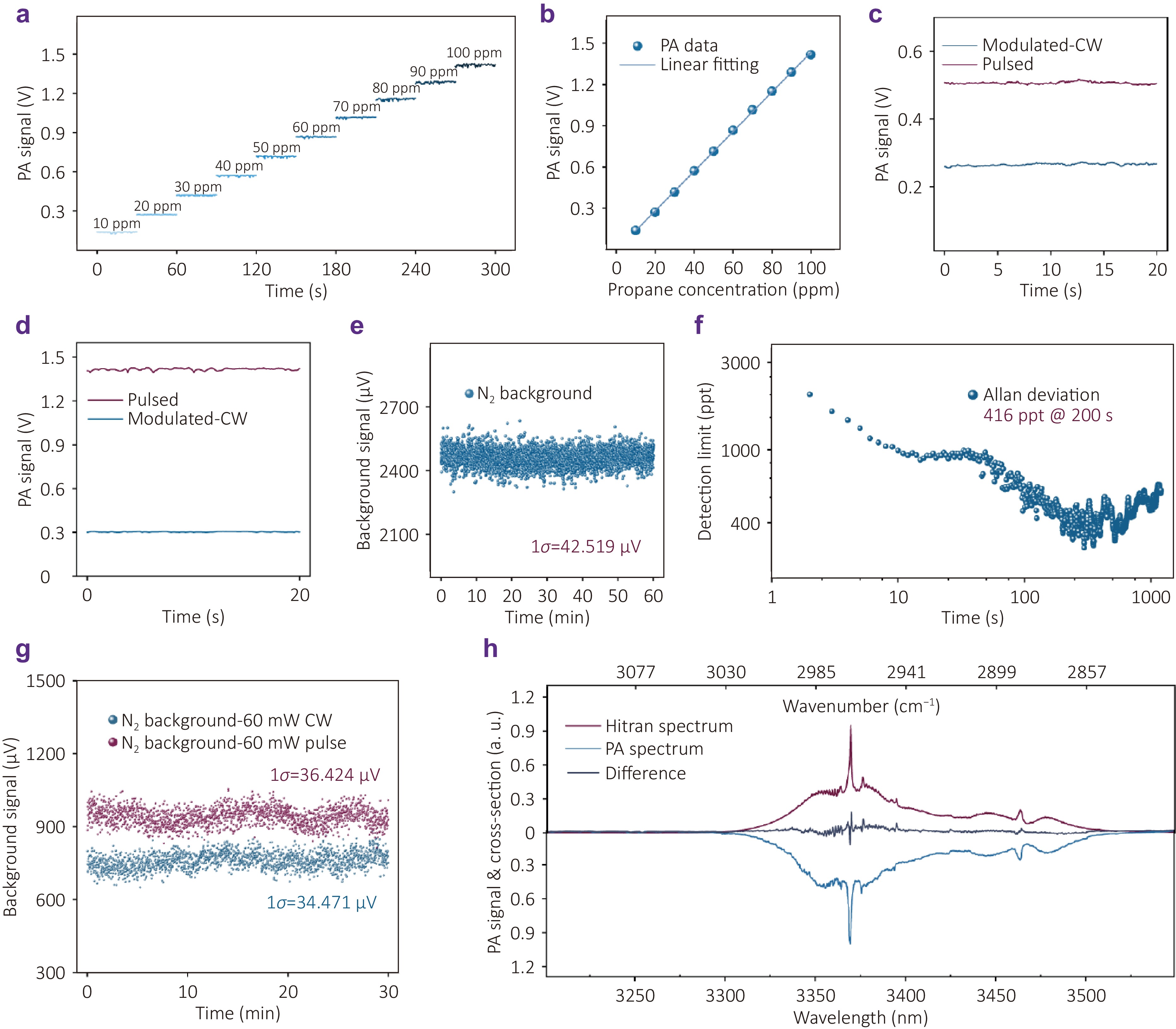
Fig. 3. Propane detection performance and spectroscopic characterization of the GS-PAS system. (a) PA signals at different propane concentrations from 10 to 100 ppm. (b) Linear fitting curve of PA signal versus propane concentraton. (c) Comparison of PA s
Announcing a new publication from Opto-Electronic Sciences; DOI 10.29026/oes.2026.260008
SHANNON, CLARE, IRELAND, April 29, 2026 /EINPresswire.com/ -- Announcing a new publication from Opto-Electronic Sciences; DOI 10.29026/oes.2026.260008
To address the pressing demands of non-invasive early screening for critical diseases and precise micro-trace monitoring of industrial pollutants, ultra-sensitive detection of volatile organic compounds (VOCs) has become a core benchmark of cutting-edge trace sensing technology. For example, trace VOCs in exhaled breath can serve as early clinical biomarkers for diseases like lung cancer and diabetes. However, their extremely low concentrations, at parts-per-billion (ppb) or parts-per-trillion (ppt) levels, make real-time, highly sensitive monitoring challenging for existing analytical methods. Photoacoustic spectroscopy (PAS) is a promising solution for trace gas detection due to its zero background, high selectivity, and compactness. The 3.2-3.5 µm mid-infrared band is optimal for this, as it covers the fundamental C-H stretching vibration bands present in almost all VOCs, enabling highly sensitive multi-gas detection. However, PAS in this band faces two main challenges. First, existing light sources, such as quantum cascade lasers (QCL) and interband cascade lasers (ICL), struggle to simultaneously deliver high power, broad tunability, and high stability. Second, traditional continuous-wave (CW) intensity modulation inevitably sacrifices over 50% of the optical power and introduces mechanical noise. Overcoming these limitations is key to achieving ppt-level detection.
To address these challenges, the research team led by Prof. Jianfeng Li at the University of Electronic Science and Technology of China proposed a photoacoustic sensing architecture driven by a gain-switched (GS) Er3+/Dy3+ co-doped mid-infrared fiber laser. Departing from traditional continuous-wave (CW) modulation, the team introduced and validated the physical mechanism of microsecond-pulse-enhanced photoacoustic spectroscopy (MPEPAS) in gas sensing for the first time. This approach successfully pushed the detection limit of propane down to 416 ppt and enabled ppb- to sub-ppb-level monitoring of multiple key VOCs, improving overall sensing performance by over an order of magnitude.
Starting from a two-level energy model, the team simulated the molecular excitation and subsequent non-radiative vibrational relaxation under microsecond pulse irradiation. By solving the inhomogeneous Helmholtz equation, they precisely modeled the energy conversion from the transient heat source into the acoustic pressure mode of the resonator. Theory and experiment jointly reveal that microsecond pulses at kHz-level repetition rates can achieve perfect coupling with the eigenfrequency of an acoustic resonator. Under equivalent average power, the exceptionally high energy conversion efficiency arising from this "thermal confinement" effect confers an intrinsic enhancement of π/2 on the photoacoustic signal, enabling ultra-strong acoustic excitation without power penalty (Fig. 1).
The compact mid-infrared fiber laser integrated into the system (Fig. 2a) demonstrates exceptional optical performance: it delivers stable near-single-transverse-mode mid-infrared output at powers up to 245 mW (Fig. 2c); through pump modulation, the repetition rate can be precisely tuned across the kHz to tens-of-kHz range, enabling perfect resonance matching with the acoustic resonator eigenfrequency. Meanwhile, owing to the efficient cascaded energy transfer between Er3+ and Dy3+ ions and the intraband absorption dynamics of Dy3+ (Fig. 2b), the architecture supports rapid broadband tuning across the 3.2-3.55 µm band with an output spectral linewidth below 0.7 cm-1, achieving precise coverage of the molecular fingerprint region associated with key C-H stretching bonds (Fig. 2d). This laser architecture, combining high power, broad tunability, and resonance-synchronized modulation, offers a highly promising solution for clinical-grade, portable VOC detection.
Leveraging this innovative GS Er3+/Dy3+ fiber laser architecture, the system achieves up to a 4-fold enhancement in photoacoustic response compared to conventional continuous-wave modulation under identical pump power. By virtue of its exceptionally high energy conversion efficiency and elevated output power, the system pushes the detection limit for propane to 416 ppt (Fig. 3f), and successfully reconstructs its broadband absorption spectrum with high-resolution fidelity (Fig. 3h). Furthermore, the system demonstrates outstanding versatility for multi-component detection, crossing the ppb-to-sub-ppb detection threshold across a range of key VOC species including aldehydes, ethers, and alkenes. This work not only advances the overall performance of existing photoacoustic VOC sensing technology by more than an order of magnitude, but also through its combined merits of ultra-high sensitivity, broadband tunability, and compact form factor, provides a powerful sensing tool with strong translational potential for precision monitoring of industrial exhaust and non-invasive clinical breath diagnostics.
Keywords: photoacoustic spectroscopy, mid-infrared fiber laser, volatile organic compounds, trace gas detection
# # # # # #
Li Jianfeng is a Professor and PhD Supervisor at the School of Optoelectronic Science and Engineering, University of Electronic Science and Technology of China (UESTC). He serves as the Director of the Advanced Laser Center and Chair Professor of Optoelectronic Information Science. He is a recipient of the National Excellent Young Scientists Fund, a Marie-Curie Incoming Fellow of the European Union, a Distinguished Young Scholar of Sichuan Province, and an Academic and Technical Leader of Sichuan Province. He was also selected as an Elsevier Highly Cited Chinese Researcher in 2020 and 2023. His main research interests include mid-infrared fiber lasers, ultrafast lasers, laser photoacoustic detection, and intelligent lasers. He has led more than twenty national-level research projects. As the first or corresponding author, he has published over 100 SCI-indexed papers, which have received more than 3,000 citations in the SCIE database. His research achievements were selected for the “Top Ten Optical Advances in China (Basic Research)” in 2017, and he received the Second Prize of the Technical Invention Award from the Chinese Society for Optical Engineering (10th edition).
# # # # # #
Opto-Electronic Science (OES) is a peer-reviewed, open access, interdisciplinary and international journal. OES has been indexed in ESCI, Scopus, DOAJ, and CAS databases, with a Scopus CiteScore Tracker of 30.7 for 2025 and a JCR Immediate Impact Factor of 26.
# # # # # #
More information: https://www.oejournal.org/oes
Editorial Board: https://www.oejournal.org/oes/editorialboard/list
All issues available in the online archive (https://www.oejournal.org/oes/archive)
Submission of OES may be made using ScholarOne (https://mc03.manuscriptcentral.com/oes)
CN 51-1800/O4
ISSN 2097-0382
Contact Us: oes@ioe.ac.cn
Twitter: @OptoElectronAdv (https://twitter.com/OptoElectronAdv?lang=en)
WeChat: OE_Journal
# # # # # #
Wang SY, Zhao L, Luo HY et al. Ppt-level volatile organic compounds detection via microsecond-pulse-enhanced mid-infrared photoacoustic. Opto-Electron Sci 5, 260008 (2026). DOI: 10.29026/oes.2026.260008
Opto-Electronic Science Editorial Office
Opto-Electronic Science
+86 591 2286 1222
email us here
Legal Disclaimer:
EIN Presswire provides this news content "as is" without warranty of any kind. We do not accept any responsibility or liability for the accuracy, content, images, videos, licenses, completeness, legality, or reliability of the information contained in this article. If you have any complaints or copyright issues related to this article, kindly contact the author above.
